
Questioning the Nature of Spirituality
This topic began my journey of questioning what spirituality is truly about. I never really believed in organized religion, as it seemed to be built around stories that didn’t hold up to historical or factual scrutiny.
Historical Inconsistencies Across Religions
For example, there is no historical record of the Jewish exodus from Egypt. The Five Books of Moses appear to have originated from Greece around 400 BC. Jesus wasn’t officially recognized as “Jesus” until the Council of Nicaea in 325 AD, and evidence suggests that Mohammed lived in Petra — where Muslims originally prayed for more than a hundred years before Mecca even existed. There are around thirty different versions of the Quran, each containing inconsistencies. Muslims also believe that Abraham built the Kaaba in Mecca, yet Abraham lived nearly two thousand years before Mecca was founded.
A Different Perspective on God
If these stories are inconsistent, then what should we believe in? Perhaps not a “religious God,” but rather the God of Energy — the creative force that gives rise to all life. That perspective makes spirituality much easier to define: it becomes the conscious use of energy for health, happiness, and well-being.
Who Were the Anunnaki?
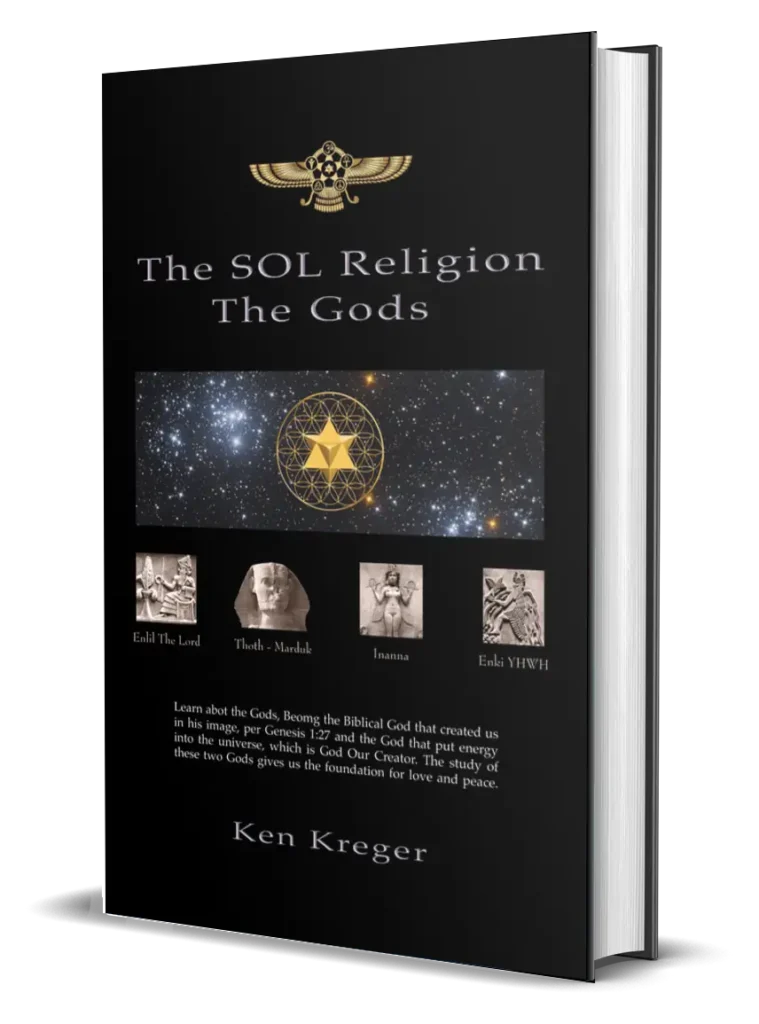
But who were the “gods” — the Anunnaki — who, according to ancient texts, created humanity in their own image (Genesis 1:27)? The Anunnaki were said to be advanced beings — humanlike in form — who engineered humankind to mine gold and serve them. Many of their beliefs and practices are reflected in the traditions we still follow today.
Arrival of the Anunnaki on Earth
According to ancient Sumerian accounts, the Anunnaki arrived on Earth roughly 500,000 years ago, led by Enki, son of King Anu (hence the name Anu-naki), and his brother Enlil. Humans were created around 232,000 years ago to assist them.
Their Technology and Influence
The Anunnaki lived extraordinarily long lives. After the Earth was populated, Enki and Enlil returned to their home planet, Nibiru, which is said to orbit a dark star called Nemesis within our solar system. These stories are detailed in the Earth Chronicles series by Zecharia Sitchin, as well as in ancient Sumerian tablets and Egyptian inscriptions. Descriptions portray them as towering beings — often 13 feet tall — with advanced technology, including spacecraft and flying machines. They gave early humanity the foundations of civilization: agriculture, animal domestication, mathematics, physics, and even the wheel.
Enki and the Creation of Humankind
Enki, known as Ptah in Egyptian texts, was considered Earth’s first ruler. He worked alongside his half-sister Ninmah (later called Hathor) and his son Thoth to create humankind. The Earth itself was named after Enki, as was the Age of Aquarius. These ancient gods later became the Greek Olympians and were even woven into later traditions as biblical archangels. Enki is said to have shared his own DNA with humanity.
Power Struggles Among the Gods
Enki ruled for thousands of years. His sons Marduk (the Egyptian Sun God) and Thoth also ruled Egypt. Marduk came to believe he was the supreme god — the “God of Gods” — and eventually replaced Enlil in many of the world’s myths, including the Bible. The descendants of Enki and Enlil warred against each other for centuries, culminating in legendary battles such as the Battle of Troy.
The Great Flood and Humanity’s Survival
Enlil, who resented humanity, refused to warn people about the coming Great Flood, hoping it would wipe them out. But Enki’s son Noah (born of an earthly woman) was guided by Galzu, a galactic messenger who provided the plans for a great submersible vessel. Noah used it to preserve the DNA of countless plants and animals — ensuring life’s survival.
The Cataclysm and Rebirth of Civilization
According to these ancient accounts, the Great Flood occurred when Antarctica shifted into the ocean as Nibiru passed near Earth. The event caused a 4,500-foot tidal wave, which ended an ice age and helped warm the planet — allowing life to flourish again.
Humanity’s Civilizational Beginning
Around 3800 BC, King Anu returned to Earth and granted humanity civilization and self-rule — marking the beginning of recorded history and the legacy of the gods who shaped us.