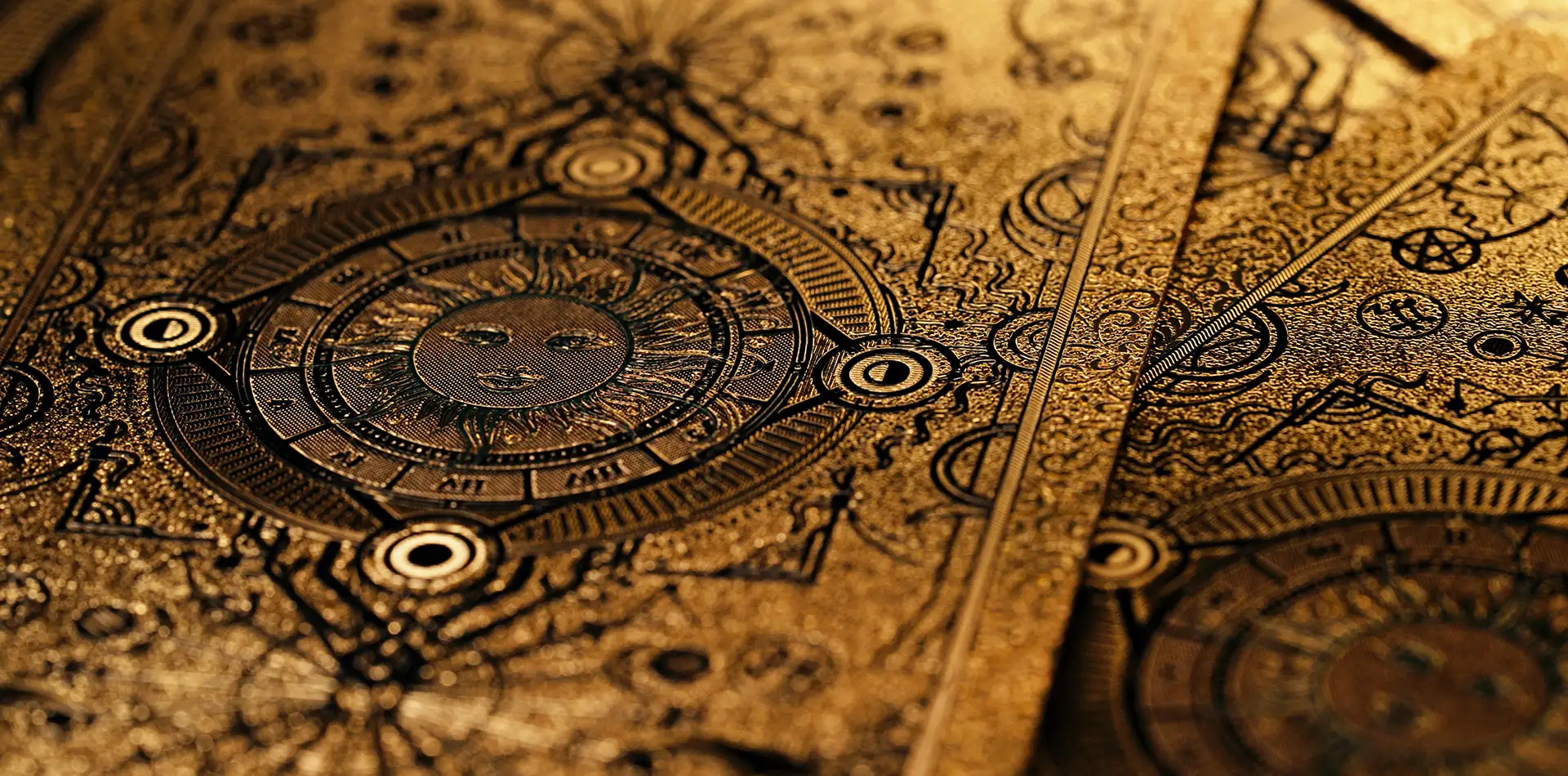
Long ago, the Ancients developed an understanding of the universe based on numbers. This era is often referred to as the Atlantean period. It was rooted in the manifestation of numbers as having powerful, almost magical qualities. This understanding was independent of language, artifacts, myths, or scriptures. Instead, it was based on the construction and reconstruction of a set of Archetypes, God’s Archetypes, not as a religious concept, but as truth. It focused on harmony, aesthetic proportions, and the building of structures.
The Shift from Numbers to Religion
After the Atlantean period, involving Thoth and other gods, humanity entered what could be described as a dark age. We forgot that numbers explain everything, from color and music to vibration and form. Instead, we were taught religion and encouraged to believe in beings said to have created us in their own image. Control and fear took hold, becoming the foundation of our culture. These values are not true and do not support love and peace. Instead, they emphasize fear, control, and power.
Celestial Geometry: Venus and the Olympics
Let’s look at two cosmic examples. Venus, over an eight-year period, traces a five-pointed star in the zodiac. This celestial pattern is numerical in nature and contains ratios of 72 degrees, a number used in mathematics and finance. Venus was named after Inanna, an ancient Anunnaki. The Olympic Games adopted a four-year cycle because Venus appears as the morning star for four years and the evening star for four more years. This cycle became the timeline for the Olympian Games.
The Power of Three and Seven
The Sun gives us two other powerful numerical markers: the solstices and the equinoxes, when Earth experiences its longest, shortest, and equal days. When we add the Moon, we arrive at the number three and the concept of the Trinity, which affects daily life through tides, seasons, and cycles. The Greeks associated the number seven with the planets, the Sun, and the Moon. Influenced by the Olympians, who were the Anunnaki, seven became embedded in human culture: the seven days of the week, seven chakras, seven colors of the rainbow, and many other symbolic systems.
The Phi Ratio and the Blueprint of Nature
When we look more closely, we see that the pentagram contains the phi ratio—the number associated with human growth. Combined with the circle, representing Earth’s orbit around the Sun, it forms the basis of vibration and the sine wave. From there, we recognize numerical progression: one, two, three, growth, and five represented by the pentagram. Adding four, symbolized by the structure of a house and its walls; six, seen in the hexagram and snowflake structures; and eight, represented by the star tetrahedron, a three-dimensional six-pointed star, we begin to see the blueprint of nature itself.
The Star of Light and One Love
From this understanding, we developed a belief system based on numbers called the Star of Light, One Love. Its value structure is rooted in nature’s numbers. It is rational, clean, and intuitive to use. We know what to believe in, and we assign spiritual concepts to numbers, such as wholeness, healing, duality, trinity, strength, and more. This approach is far simpler and more coherent than traditional religious systems, though many religious ideas overlap because they borrowed heavily from these ancient concepts. You could say that religion copied the Ancients when defining what was spiritual.
Returning to a Foundation of Energy
We take this one step further by defining spirituality as the use of numbers and sacred geometry as the foundation of a philosophy based on energy. It is time for humanity to return to this foundation for civilization, just as the Ancients once did. By doing so, we can learn to interact with one another more harmoniously and consciously.